Introduction to Messeregge
Modern farming is shifting toward smarter and more soil-friendly practices where productivity and sustainability go hand in hand. Farmers are no longer focused only on deep soil turning; instead, they are giving more importance to surface-level soil management that protects long-term fertility.
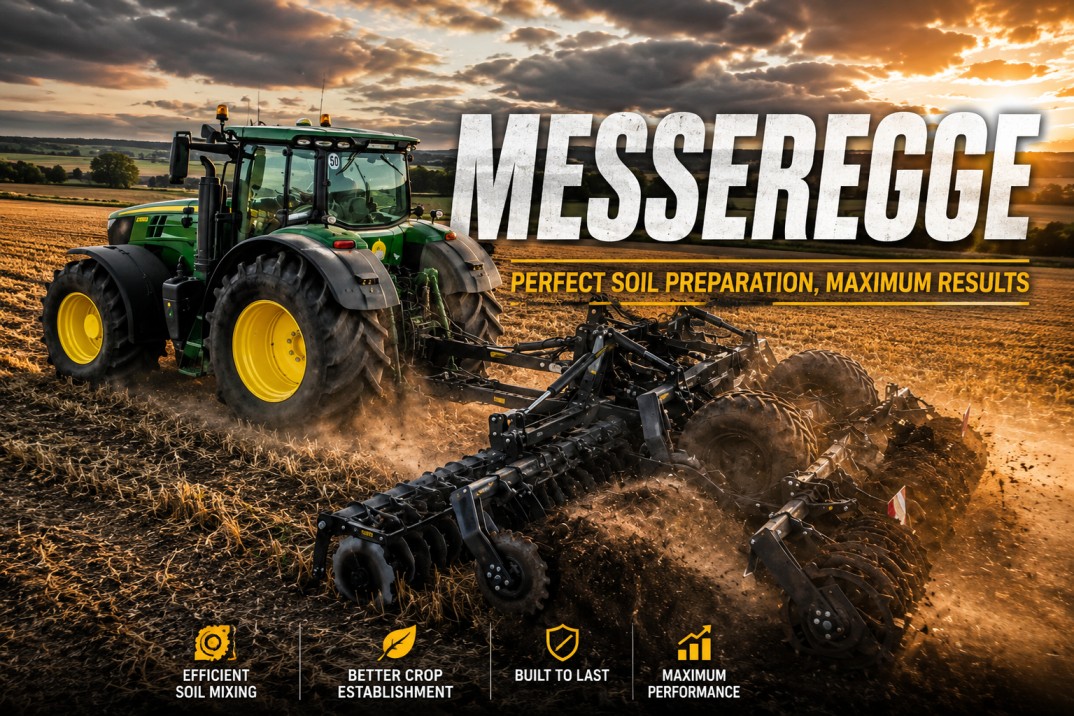
The Messeregge is one such agricultural implement designed specifically for light and shallow soil cultivation. It is commonly known as a knife harrow tool because it uses sharp blade-like elements to work the upper soil layer without disturbing deeper soil structure.
Unlike heavy tillage equipment that penetrates deep into the ground, the Messeregge operates in the top surface zone of about 1 to 5 cm depth, where most seedbed issues occur. It is widely used for breaking soil crust, improving residue distribution, and enhancing seed-to-soil contact, which ultimately supports better crop emergence and uniform growth.
In modern systems such as conservation farming and reduced tillage agriculture, this tool is gaining importance because it improves field conditions while lowering fuel use and preserving soil integrity.
Meaning and Origin of Messeregge
The term Messeregge has German roots and is formed from two agricultural words: “Messer” meaning knife and “Egge” meaning harrow. Combined, it refers to a knife-based harrowing implement used for surface soil preparation.
Historically, this type of tool was developed in European farming regions where farmers needed a way to prepare seedbeds without excessive soil disturbance. Traditional plowing methods often led to soil drying, erosion risks, and loss of surface structure. The Messeregge was introduced as a more controlled solution for gentle shallow soil working.
Over time, the design evolved from manual rural tools into modern mechanized systems used in large-scale agriculture today.
Messeregge Design and Structure
The Messeregge is built with a practical and durable structure that supports continuous field operations. Its main working component is a series of sharp steel blades arranged across a strong frame. These blades are responsible for cutting through hardened soil surfaces and managing crop residue efficiently.
The frame is designed to maintain stability even under varying soil conditions, ensuring uniform working depth throughout the field. Most modern versions are integrated with tractors using a three-point hitch system, making them easy to operate in large farms.
In advanced models, hydraulic systems allow adjustment of blade angle and working pressure. Some machines also include rollers at the rear, which help in smoothing and finishing the soil surface after primary operation.
How Messeregge Works (Working Mechanism)
The working principle of the Messeregge is based on controlled surface-level soil disturbance without inversion. It usually operates within a shallow depth range of 1–5 cm, targeting only the top layer of soil.
As the tractor moves forward, the blades penetrate the surface and create a slicing effect that breaks compacted soil layers. This process helps restore air circulation and improves water movement in the upper soil zone. It also enhances soil moisture balance and surface aeration, which are important for early plant development.
At the same time, crop residues are cut and spread more evenly across the field, preventing uneven accumulation. This improves surface protection and reduces the risk of erosion caused by wind or rain.
Field performance studies in shallow tillage systems show that such tools can reduce unnecessary field operations by nearly 20–30%, making farming more efficient in terms of time and fuel consumption.
Key Functions of Messeregge in Agriculture
The Messeregge plays multiple roles in field preparation. One of its main functions is removing hardened surface layers formed after rainfall, commonly known as soil crust. This allows seedlings to emerge more easily and improves early crop establishment.
Another important function is managing leftover plant material after harvest. Instead of burying it deep into the soil, the Messeregge breaks and spreads it evenly across the field, which supports moisture conservation and reduces soil erosion risk.
It is also used for smoothing uneven field surfaces, including wheel tracks and minor soil irregularities. This improves planting accuracy and ensures better crop uniformity across the field.
Best Time and Conditions for Use
The efficiency of the Messeregge depends greatly on soil conditions. It performs best when the soil is slightly moist, allowing blades to cut cleanly without causing smearing or clogging.
It is commonly used before planting during seedbed preparation, especially when surface crusting or residue imbalance is present. It is also effective after rainfall when the soil surface becomes compacted or sealed.
However, it should not be used in overly wet soil conditions, as this can lead to soil compaction instead of proper cutting action. Extremely dry soil can also reduce its efficiency due to increased resistance.
Advantages of Messeregge
The Messeregge is valued for its role in sustainable agriculture. One of its most important advantages is that it causes very minimal soil disturbance, helping preserve natural soil layers and biological activity.
It also improves seed placement conditions by creating a more uniform surface, which enhances seed-to-soil contact and supports better germination rates. In many farming environments, improved surface preparation can lead to noticeably more uniform crop emergence.
Another major advantage is reduced fuel usage. Since the tool works only on the surface layer, it requires significantly less tractor power compared to deep tillage equipment, lowering operational costs and improving efficiency.
Limitations of Messeregge
Despite its usefulness, the Messeregge is not suitable for all farming situations. It cannot handle deep compaction problems or hardpan layers that require deeper mechanical intervention.
Its performance also depends heavily on correct timing and soil moisture conditions. If used incorrectly, it may reduce efficiency or damage surface structure instead of improving it.
Additionally, blade wear over time can affect cutting quality if regular maintenance is not performed.
Messeregge vs Other Farming Tools
Compared to a disc harrow, the Messeregge operates at a much shallower level and avoids aggressive soil mixing. Disc harrows are designed for deeper cultivation, while the Messeregge focuses on surface refinement and precision work.
In comparison with spike-tooth or chain harrows, the Messeregge provides a more controlled cutting action due to its knife-based blades. This allows it to handle tougher surface crust conditions more effectively.
Overall, the Messeregge is more suitable for farmers who want balanced surface preparation without disturbing deeper soil layers.
Modern Role of Messeregge in Agriculture
The Messeregge is becoming increasingly relevant in modern sustainable farming systems such as conservation agriculture and regenerative farming. These systems aim to reduce soil disturbance, improve soil health, and maintain long-term productivity.
Because it supports surface-level soil management while preserving deeper layers, it fits perfectly into modern farming strategies focused on efficiency and environmental protection.
Conclusion
The Messeregge is a highly efficient agricultural tool designed for precise surface soil management. It plays an important role in improving seedbed quality, breaking soil crust, and managing crop residue without disturbing deeper soil layers.
Its ability to combine efficiency with soil protection makes it a valuable implement in modern farming systems. As agriculture continues to move toward sustainability and reduced tillage practices, the importance of tools like the Messeregge is expected to grow even further.
Visit For More Info: Cast Magazine