
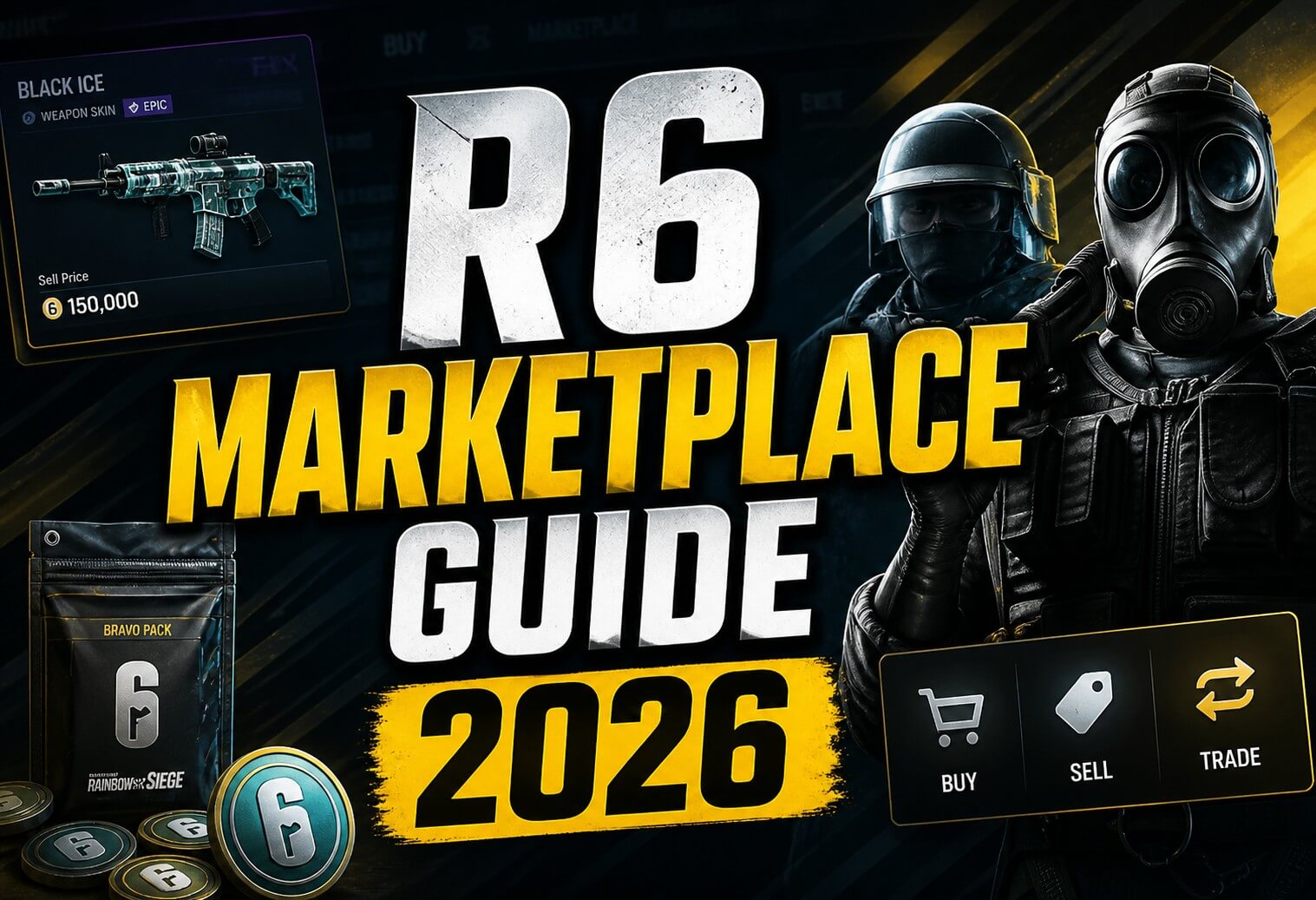
The R6 Marketplace has completely changed how players interact with cosmetics in Rainbow Six Siege. Instead of relying only on random packs or fixed in-game store bundles, players now participate in a dynamic player-driven economy where skins, charms, and bundles hold real trading value.
This system uses R6 Credits as its main currency and is built around real-time supply and demand. Because of this structure, the Rainbow Six Siege marketplace economy behaves more like a digital trading market than a traditional in-game shop.
Unlike older systems, success in the R6 item marketplace is not based on luck, but on understanding timing, pricing behavior, and market psychology.
What Is the R6 Marketplace?
The R6 Marketplace is Ubisoft’s official trading platform where players can buy and sell cosmetic items such as weapon skins, operator uniforms, charms, and limited-edition bundles.
What makes this system unique is that it is fully player-driven, meaning prices are not fixed. Instead, the value of each item in the R6 skins marketplace depends on how many players want it versus how many are selling it.
For example, items like Black Ice skins or Glacier bundles often increase in value over time because they are no longer easily obtainable. On the other hand, common items tend to lose value quickly due to oversupply.
This creates a living economy where every item has a fluctuating market price.
How the R6 Marketplace Works (Real Trading Logic)
The R6 marketplace trading system is based on an order-book model, similar to real financial markets. Players place buy and sell orders instead of purchasing directly from a fixed store.
Buyers set the maximum price they are willing to pay, while sellers set the minimum price they are willing to accept. When both values match, the trade is automatically completed.
This system creates constant price movement in the R6 item marketplace, where even small changes in demand can shift prices.
Real Market Example:
If a rare skin has only a few sellers but many buyers, the price increases naturally.
If many players try to sell the same item quickly after an event, the price drops sharply.
This is why experienced traders focus heavily on R6 marketplace price tracking and timing, not just random buying.
Understanding R6 Credits (Marketplace Economy Core)
The entire system runs on R6 Credits, the official currency used in Rainbow Six Siege.
Players use credits to buy items, place buy orders, and complete trades. However, Ubisoft applies a transaction fee on sellers, meaning not all credits from a sale are received.
This creates an important economic behavior: successful traders focus on high-margin trades instead of small random flips.
From a real trading perspective, R6 Credits act like “investment capital” inside the Rainbow Six Siege marketplace economy, where smart reinvestment matters more than one-time gains.
Market Behavior
Understanding how the marketplace behaves is more important than knowing how to use it.
In real trading experience, prices in the R6 skins marketplace are heavily influenced by player psychology. When a new season launches, many players rush to sell old items quickly, causing temporary price drops. This is known as a panic sell phase.
However, experienced traders do not sell during this phase. Instead, they wait for the market to stabilize and buy undervalued items.
Later, when demand returns, prices often rise again, creating profitable opportunities.
This cycle is one of the core reasons why R6 marketplace flipping strategies work consistently over time.
How to Buy Items in R6 Marketplace
Buying items in the R6 item marketplace requires more than just selecting a skin. Players must analyze timing, demand, and price history before making a purchase.
Items can be bought instantly or through buy orders, depending on availability. However, experienced users rarely buy at peak prices.
Practical Buying Insight:
For example, after an esports event ends, many event-related skins temporarily lose value as players flood the market. Smart buyers wait for this moment and purchase at lower prices.
This is where R6 marketplace price tracking becomes essential, as it helps identify when an item is undervalued.
How to Sell Items and Maximize Profit
Selling items in the R6 marketplace trading system is where profit is actually generated.
Each listing must be carefully priced based on current demand and competitor listings. Overpricing leads to expired listings, while underpricing reduces profit margins.
From real trading behavior, the most successful sellers follow one rule:
“Sell based on market momentum, not personal value.”
If an item is trending upward due to scarcity, it can be priced slightly higher. If the market is saturated, quick selling is more effective.
This balance is key in the R6 skins marketplace economy.
How Profit Works in R6 Marketplace (Flipping Strategy)
The most effective method to earn credits is through R6 marketplace flipping strategies.
The concept is simple: buy low, sell higher. However, execution depends on timing.
Real Example:
A player buys a skin for 420 credits during a low-demand period. After demand increases, the same item sells for 500 credits. After fees, profit is still achieved.
Although individual gains may look small, repeated cycles create compounding growth over time.
This is why experienced traders treat the R6 item marketplace like a long-term investment system rather than a quick-profit tool.
High-Value Items in R6 Marketplace
Not all items behave the same in the marketplace. Some cosmetics consistently hold value due to rarity and demand cycles.
High-value items in the R6 skins marketplace include Black Ice skins, Glacier bundles, Pro League sets, and limited-time event cosmetics.
These items maintain value because they are either discontinued or extremely limited in circulation.
This scarcity effect is one of the strongest forces driving the Rainbow Six Siege marketplace economy.
Why Prices Change (Market Psychology)
Prices in the R6 marketplace trading system are not random. They follow predictable patterns based on player behavior.
When a new season releases, older items often drop in price because players shift attention to new content. However, rare items recover value later as collectors re-enter the market.
This cycle of “drop and recovery” is a key opportunity for traders who understand R6 marketplace price tracking trends.
Common Mistakes Players Make
Many new players lose credits because they treat the marketplace emotionally instead of logically.
Common mistakes include buying during hype peaks, ignoring fees, overpricing items, and not tracking price trends.
In real trading behavior, emotional decisions are the biggest cause of losses. Successful traders rely on data, timing, and patience instead of impulse buying.
Final Thoughts
The R6 Marketplace is not just a cosmetic system—it is a fully functioning digital economy inside Rainbow Six Siege.
Players who understand market behavior, pricing patterns, and R6 marketplace flipping strategies can consistently grow their R6 Credits and build valuable inventories over time.
Success in the R6 item marketplace comes from knowledge, timing, and discipline—not luck.
FAQ – R6 Marketplace
1. What is the R6 Marketplace?
The R6 Marketplace is Ubisoft’s official system where players buy and sell cosmetics using R6 Credits in a player-driven economy.
2. How does the R6 Marketplace work?
It uses an order system where buyers and sellers set prices, and trades happen automatically when they match.
3. Can you make profit in R6 Marketplace?
Yes, players can profit by buying low and selling high using R6 marketplace flipping strategies.
4. What are R6 Credits used for?
R6 Credits are used to buy, sell, and trade cosmetic items in the marketplace.
5. What are the best items to trade?
Black Ice skins, Glacier bundles, and rare event cosmetics are the most valuable items.
6. Is the R6 Marketplace safe?
Yes, it is safe as it is officially managed by Ubisoft and protected with 2FA security.
7. Why do prices change?
Prices change due to supply, demand, updates, and player activity in the marketplace.
8. How can beginners avoid loss?
Beginners should avoid hype buying and focus on small, low-risk trades.
9. Do prices increase over time?
Rare items often increase in value, while common items usually decrease.
10. What is the best beginner strategy?
Start with small trades, learn price trends, and reinvest profits slowly.
Visit For More Info : Cast Magazine